

How to correctly match the subwoofer and satellites: crossover cutoff frequency, phase and volume balance
Powerful subwoofers and high-quality satellite speakers do not necessarily guarantee balanced sound. Even a professional sound system can lose detail, produce excessive rumble, or lack bass in certain areas of a venue. The problem often lies not in the equipment specifications but in improper frequency distribution, phase discrepancies, and incorrect signal level settings. For mobile DJs, live sound engineers, musicians, and owners of small clubs, understanding these processes is essential for delivering high-quality sound at events.
Why Does a Subwoofer + Satellite Speaker Setup Require Proper Adjustment?
One of the most common mistakes when setting up a live sound system is connecting an active subwoofer at maximum volume alongside full-range top speakers without configuring the frequency filters. At first glance, this approach might seem to provide more powerful bass, but in practice, it often produces the opposite effect. Low-frequency components overlap, the sound becomes boomy and poorly controlled, and the impact of the kick drum loses definition.
These shortcomings are particularly noticeable when playing electronic dance music and during live performances. If the satellite speakers continue operating at extremely low frequencies, their drivers undergo greater excursion, increasing the load on the amplifiers and potentially compromising midrange reproduction. At the same time, incorrect phase alignment can cause partial cancellation of sound waves, even when sufficient power headroom is available.
Effective system tuning is based on three principles: proper frequency distribution using a crossover, alignment of the phase and arrival time of sound waves, and balancing sound pressure levels. The active Maximum Acoustics POWERCLUB.18SUB subwoofer helps implement these principles with its built-in low-frequency crossover and bass level control.
Crossover Frequency: How to Distribute Low Frequencies Correctly
A crossover determines which frequencies are reproduced by the subwoofer and which are handled by the satellite speakers. If the speakers operate across an excessively wide overlapping frequency range, there is a risk of an uneven frequency response. For example, when the top speakers reproduce frequencies starting at 50 Hz and the subwoofer covers the range from 38 to 120 Hz, a significant portion of the low-frequency spectrum is reproduced by both systems simultaneously. Depending on their positioning and phase characteristics, this can cause excessive amplification of certain frequencies or undesirable dips in the frequency response.
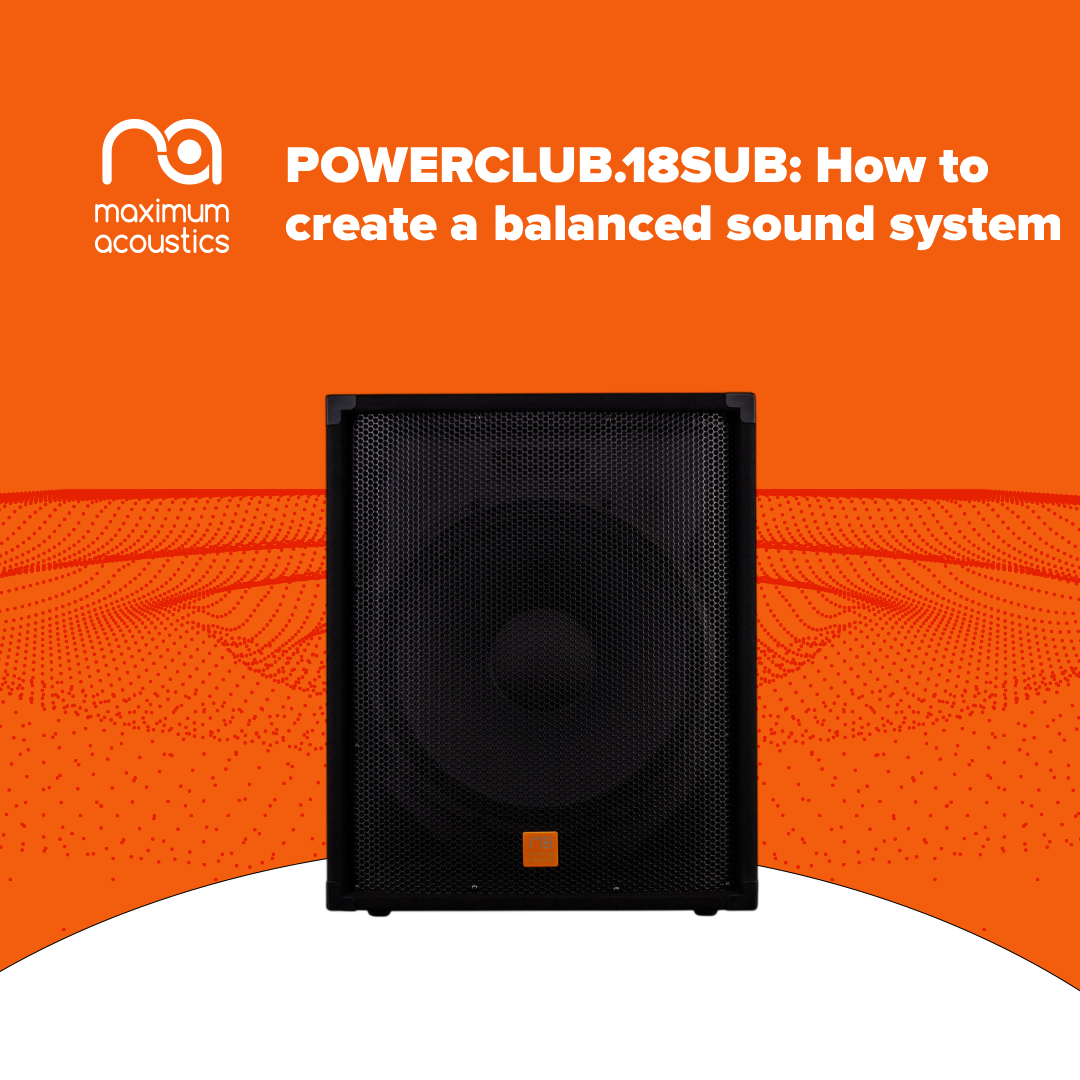
The active Maximum Acoustics POWERCLUB.18SUB is designed to reproduce low frequencies within the 38–120 Hz range. Its 18-inch driver features a 3-inch voice coil, allowing the subwoofer to reproduce the powerful bass components of musical content. The built-in crossover and Low Pass control make it possible to limit the upper frequency range reproduced by the subwoofer and coordinate its operation with the main speakers.
For most compact live sound systems, a crossover frequency between 80 and 120 Hz is a practical starting point. The exact setting depends on the capabilities of the satellite speakers, filter characteristics, and the acoustic conditions of the venue. Top speakers equipped with 12-inch or 15-inch low-frequency drivers generally integrate well with a subwoofer within this range, although the final settings should be verified through listening tests or acoustic measurements.
It is important to understand that the Low Pass filter limits the upper frequencies reproduced by the subwoofer itself. To relieve the satellite speakers of the lowest frequencies, a High Pass filter must also be applied, provided it is available in the top speakers, an external processor, or a DSP system. Proper frequency distribution reduces excessive cone excursion in the satellite speakers, preserves amplifier headroom, and contributes to cleaner reproduction of vocals, guitars, and other midrange instruments.
Phase and Speaker Placement: Why Does Bass Disappear in Certain Areas of a Venue?
Low-frequency sound has long wavelengths, so even relatively small differences in the distances between speakers can noticeably affect the result. For example, at 60 Hz, the wavelength of sound in air is approximately 5.7 meters. If sound waves from the subwoofer and satellite speakers reach the listener with an unfavorable phase difference, their vibrations partially cancel each other out.
This is how characteristic acoustic nulls occur, where bass sounds powerful near the stage but almost disappears just a few meters away. Low-frequency behavior is also influenced by walls, room corners, sound reflections, and the relative positioning of the speakers.
One practical way to simplify the geometry of a sound system is to position a satellite speaker directly above the subwoofer. The Maximum Acoustics POWERCLUB.18SUB features a top-mounted 1-3/8-inch pole socket, corresponding to a diameter of 35 mm. Using a compatible adjustable speaker pole, the top speaker can be positioned above the subwoofer along a shared vertical axis. This configuration reduces the horizontal separation between sound sources and makes subsequent alignment easier, although it does not guarantee complete time alignment on its own.
Phase alignment can be checked without sophisticated measuring equipment. To do this, play a mono music track with a strong, consistent bass line, set a moderate operating volume, and listen to the system in the main audience area. If the equipment has a 0°/180° polarity switch, compare both positions and determine which setting produces tighter, more consistent bass around the crossover frequency.
If no polarity switch is available, adjustments can be made using an external DSP processor with a signal delay function. However, it is important to remember that reversing polarity does not replace accurate time alignment. For professional live sound installations where precision is essential, the best results are achieved by measuring the system's phase and frequency response.
Volume Balance: How to Achieve Powerful Bass Without Clipping
Even a correctly configured crossover frequency will not deliver high-quality sound if the subwoofer operates with an excessively high signal level. In professional audio, this process is controlled through the principle of Gain Staging, which involves systematically matching signal levels at every stage of the audio signal chain.
The Maximum Acoustics POWERCLUB.18SUB subwoofer has a rated power output of 500 W and a peak power output of 1000 W. Its specified sensitivity is 97 dB, while the maximum sound pressure level reaches 119 dB. These specifications make the model a suitable foundation for the low-frequency section of mobile DJ systems, local concerts, and small entertainment venues.
However, having substantial power headroom does not mean that the Sub Level control should be turned to its maximum setting. Excessive gain can overload the input or output stages, causing clipping and distortion of the audio signal. As a result, instead of tight, controlled low-frequency impact, listeners hear a monotonous rumble that masks vocals and rhythmic details.
Proper adjustment begins with the mixer. First, set appropriate levels for the input channels and main output, ensuring that the overload indicators do not remain continuously illuminated. Next, bring the satellite speakers to a comfortable operating volume and gradually increase the subwoofer level using the Sub Level control. The optimal balance is achieved when the low-frequency foundation can be physically felt without overwhelming the midrange or disrupting the natural balance between musical instruments.
To verify the settings, use several familiar tracks with varying amounts of bass content. If the system sounds convincing with one track but the low frequencies begin to dominate with another, the subwoofer level and crossover settings should be reassessed.
Connections and Signal Routing: Proper Stereo System Setup
A professional sound system requires not only high-quality drivers and amplifiers but also a well-planned arrangement of signal connections. This is especially important for mobile DJs and sound equipment rental companies that regularly change their equipment configurations depending on the scale of an event.
The Maximum Acoustics POWERCLUB.18SUB connection panel features two balanced female XLR inputs for connecting the left and right channels of a mixer. The model is also equipped with four male XLR output connectors, expanding the available connection options for other components of the sound system.
In a typical configuration, the stereo signal from the mixer is sent to the subwoofer's L/R inputs, after which the corresponding line-level signals can be routed to active satellite speakers or other compatible devices. Before making connections, it is necessary to verify the purpose of the output connectors and whether filtering is applied along the specific signal path. If the outputs operate in pass-through mode, the satellite speakers will receive a full-range signal, meaning their High Pass filters must be configured separately.
Balanced XLR connections are particularly important at live venues with numerous power cables, lighting systems, and electronic devices. Differential signal transmission helps suppress common-mode electromagnetic interference, including 50 Hz mains hum. This allows longer signal cable runs with a reduced risk of unwanted noise, provided that the cables are correctly installed and the equipment is functioning properly.
Maximum Acoustics POWERCLUB.18SUB: A Reliable Foundation for Balanced Live Sound
Proper alignment of a subwoofer and satellite speakers allows you to get significantly more performance from an existing sound system without unnecessarily increasing the volume. A correctly selected crossover frequency ensures that the workload is distributed between the drivers, phase alignment helps prevent unwanted dips in the bass range, and proper Gain Staging maintains signal clarity even during dynamic musical performances.
The active Maximum Acoustics POWERCLUB.18SUB combines a powerful 18-inch low-frequency driver, a built-in crossover, adjustable bass level, and extensive XLR connectivity options. These features make the model a practical solution for DJs, musicians, sound equipment rental companies, and venue owners who need a defined and controlled low-frequency foundation.
You can learn more about the POWERCLUB.18SUB, its technical specifications, and its integration into a live sound system in our catalog. Carefully selected equipment and precise adjustment of each component will help create powerful, clean, and balanced sound for events of various formats.
Leave your comment