

Low-Cut Button (HPF 80–100 Hz): Why It’s the Most Important Switch on a Live Sound Mixer
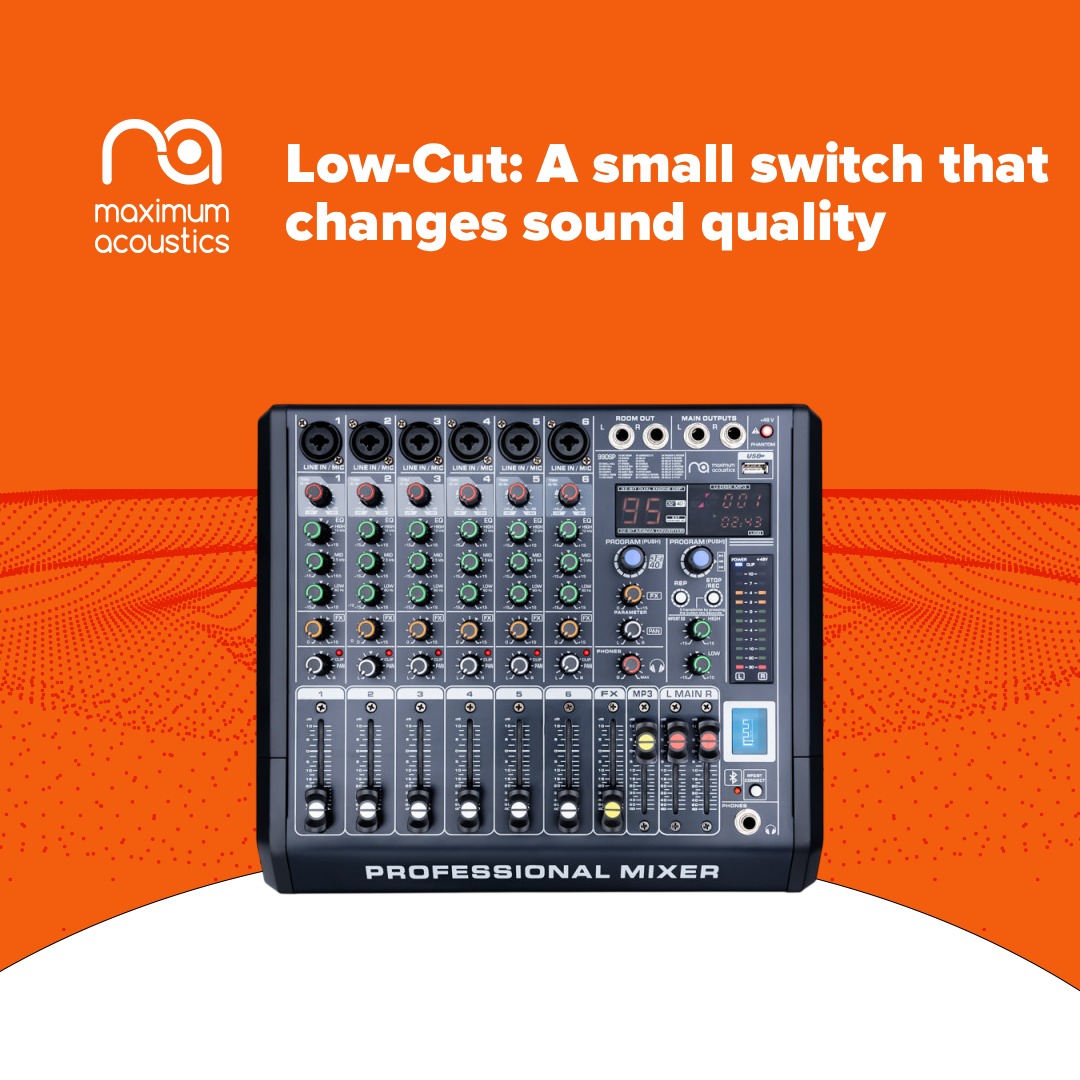
On most analog mixing consoles, there is a small button next to the Gain control labeled 80 Hz, 100 Hz, HPF, or marked with a special frequency cutoff symbol. At first glance, it may seem like a secondary feature, which is why many beginners do not even touch it when setting up their equipment. There is a common misconception that Low-Cut removes bass, makes voices sound thin, and deprives music of its richness. In reality, the opposite is true: using this switch correctly helps achieve cleaner, more powerful, and better-balanced sound.
Unwanted low-frequency signals are often responsible for overloading sound systems, causing distortion, making a presenter's voice sound muffled, and reducing bass clarity. The amplifier uses part of its available power to reproduce vibrations that contain no useful musical information. As a result, even high-quality equipment may perform significantly below its potential. Let's explore why activating Low-Cut on most microphone channels is considered one of the fundamental principles of professional live sound and how this feature helps unlock the potential of Maximum Acoustics mixing consoles.
What Does Low-Cut Actually Do, and Why Is It Called HPF?
The terms Low-Cut and High-Pass Filter refer to the same function, although they describe it from different perspectives. The first literally means cutting low frequencies, while the second refers to a filter that allows higher frequencies to pass through. Its purpose is to pass most of the signal above the selected cutoff frequency while progressively attenuating frequencies below it.
Mixing consoles designed for live sound often feature fixed filters at 80 or 100 Hz. It is important to understand that this is not a sharp boundary beyond which the sound instantly disappears. Filtering occurs gradually, with many models offering a roll-off slope of 12 or 18 dB per octave. For example, if a filter has a slope of 18 dB per octave, lowering the frequency by one octave results in approximately 18 dB of additional attenuation relative to the characteristic level near the cutoff frequency. This makes unwanted low-frequency vibrations significantly quieter while preserving the natural sound of the main vocal frequency range.
The fundamental difference between Low-Cut and the standard LOW control on an equalizer lies in how they process the signal. A low-frequency EQ control typically operates as a shelving equalizer, gradually boosting or reducing a broad range of bass frequencies. In contrast, an HPF provides progressively stronger attenuation below a specified cutoff point. This makes it more effective at eliminating subsonic noise, vibrations, and unwanted acoustic interference without unnecessarily altering the overall low-frequency balance.
Four Reasons to Enable Low-Cut at Every Event
1. Preserving Amplifier Power and Increasing Headroom
Low frequencies require substantial energy to reproduce, especially when powerful sound systems and subwoofers are involved. The stronger the bass signal, the greater the demands placed on the amplifier and the mechanical excursion of the speaker drivers. However, a significant portion of low-frequency energy may come not from musical instruments but from wind noise, impacts on microphone stands, or accidental contact with microphone housings.
When these signals enter the audio signal chain, they reduce the available level margin, commonly known as headroom. During particularly strong low-frequency impulses, the amplifier or individual processing stages may reach their overload limits, resulting in clipping and unpleasant distortion. Activating Low-Cut reduces unnecessary energy in the signal, helping the system use its available power more efficiently.
This is particularly important for mobile DJs, corporate event hosts, and owners of small concert venues. A properly configured HPF helps produce cleaner sound without constantly increasing the overall volume.
2. Eliminating Mechanical Rumble, Stage Vibrations, and Footstep Noise
Even a well-equipped venue is not immune to mechanical vibrations. People walking near microphone stands, vibrations from wooden stages, moving cables, physical contact with microphones, and ventilation equipment can all generate low-frequency noise. Much of this vibration energy falls within approximately 20–60 Hz, although its frequency spectrum may extend beyond this range.
The problem is that microphones convert these mechanical disturbances into electrical signals, which enter the mixer along with speech or music. After amplification, the rumble becomes noticeable in the overall sound, while subwoofers may reproduce deep thumps that have nothing to do with the performance.
The Low-Cut filter significantly attenuates these vibrations at the input channel stage. The difference is especially noticeable during weddings, conferences, presentations, and concerts held on temporary stages. However, an HPF does not replace proper microphone mounting, shock mounts, or correct cable routing.
3. Compensating for the Proximity Effect and Reducing Plosive Sounds
When working with vocals and speech, sound engineers frequently encounter a phenomenon known as the Proximity Effect. It occurs when a performer or presenter positions a directional microphone very close to their lips. In this situation, low frequencies become unnaturally emphasized, making the voice sound excessively deep, boomy, and less intelligible.
This effect is particularly noticeable with cardioid microphones, which are widely used for live performances. Although additional bass emphasis can sometimes help create a distinctive broadcast-style voice, it often prevents vocals from cutting clearly through the music during concerts.
Activating Low-Cut helps partially compensate for excessive low frequencies and restore a more natural vocal character. The filter also helps reduce dull thumps caused by plosive consonants such as “P” and “B,” when bursts of air strike the microphone diaphragm directly.
However, an HPF cannot completely replace a windscreen or pop filter. The best results come from combining proper microphone technique, an appropriate distance from the capsule, and carefully adjusted frequency processing.
4. Reducing Subwoofer Load and Creating Space for Real Bass
In a well-balanced musical mix, every instrument should occupy its own place in the frequency spectrum. The deepest bass is typically produced by the kick drum, bass guitar, or synthesizer parts. These sources require full reproduction of low-frequency energy. If the low frequencies from several vocal microphones, an acoustic guitar, and other instruments are simultaneously routed through the subwoofer, the overall sound may become overloaded and muddy.
This phenomenon is commonly referred to as frequency masking. Excessive low-frequency content makes individual instruments harder to distinguish, so even a powerful sound system may produce a muddy wall of sound instead of tight, defined bass.
Using Low-Cut on channels that do not require deep bass frequencies helps create space for the main low-frequency instruments. Vocals become more expressive, acoustic guitars are easier to distinguish in the mix, and kick drum hits gain greater definition.
However, this does not mean that HPF should be activated indiscriminately on every channel. For bass guitars, electronic bass sounds, and kick drums, the cutoff frequency must be selected individually to avoid unintentionally removing essential elements of their sound.
Why Is the Low-Cut Function Important When Choosing a Maximum Acoustics Mixer?
When selecting a mixing console, buyers often focus primarily on the number of channels, built-in effects, connectivity options, and equalizer controls. However, convenient input signal management is equally important, especially when the equipment is used for live performances.
In this context, Maximum Acoustics mixing consoles should be evaluated not only by their core features but also by their frequency control capabilities. The presence of a dedicated Low-Cut switch on applicable models allows users to quickly reduce unwanted low frequencies without complicated equalizer adjustments. This is a practical advantage for presenters, musicians, mobile DJs, and HoReCa venue staff who need their sound systems to operate reliably for extended periods.
Well-designed controls are particularly useful when preparation time is limited. The ability to quickly configure microphone channels, check input sensitivity, and adjust the low-frequency balance helps prevent common mistakes before a performance begins.
Three Seconds That Can Transform the Sound of an Entire Event
The Low-Cut button does not degrade bass. Instead, it helps keep bass where it truly belongs. Proper HPF use reduces mechanical noise, improves speech intelligibility, increases available headroom, and lowers the risk of overloading the sound system. It is one of the simplest ways to improve live sound quality without investing in additional equipment.
Before every event, it takes only a few seconds to check the microphone channels. If a sound source does not need to reproduce deep bass, activating Low-Cut and evaluating the result by ear is a sensible approach. For most speech microphones and many instrument channels, this is an excellent starting point for sound adjustment.
Maximum Acoustics mixing consoles equipped with appropriate frequency processing features make live sound management more convenient and provide control over every signal source. You can explore the available mixing equipment in our catalog, which features solutions for musicians, sound engineers, event presenters, and professional venue sound reinforcement.
Leave your comment