

5 reasons why amplifiers burn out and how to avoid it
Professional audio equipment is not just hardware — it is an investment in the stable operation of a venue, a high-quality event, and the reputation of a specialist. For the owner of a café or restaurant, a sudden sound shutdown during an event means dissatisfied guests. For a DJ, it means a ruined performance. For a beginner sound engineer, it means stress, extra expenses, and unpleasant lessons for the future.
When an amplifier starts overheating, shutting down, or, in the worst case, “smoking” in the middle of a concert, the problem rarely happens by accident. In most situations, it could have been prevented before the work even started. It is enough to understand why amplifiers fail, how to choose the right load, and why protection systems in modern equipment have practical rather than decorative value.
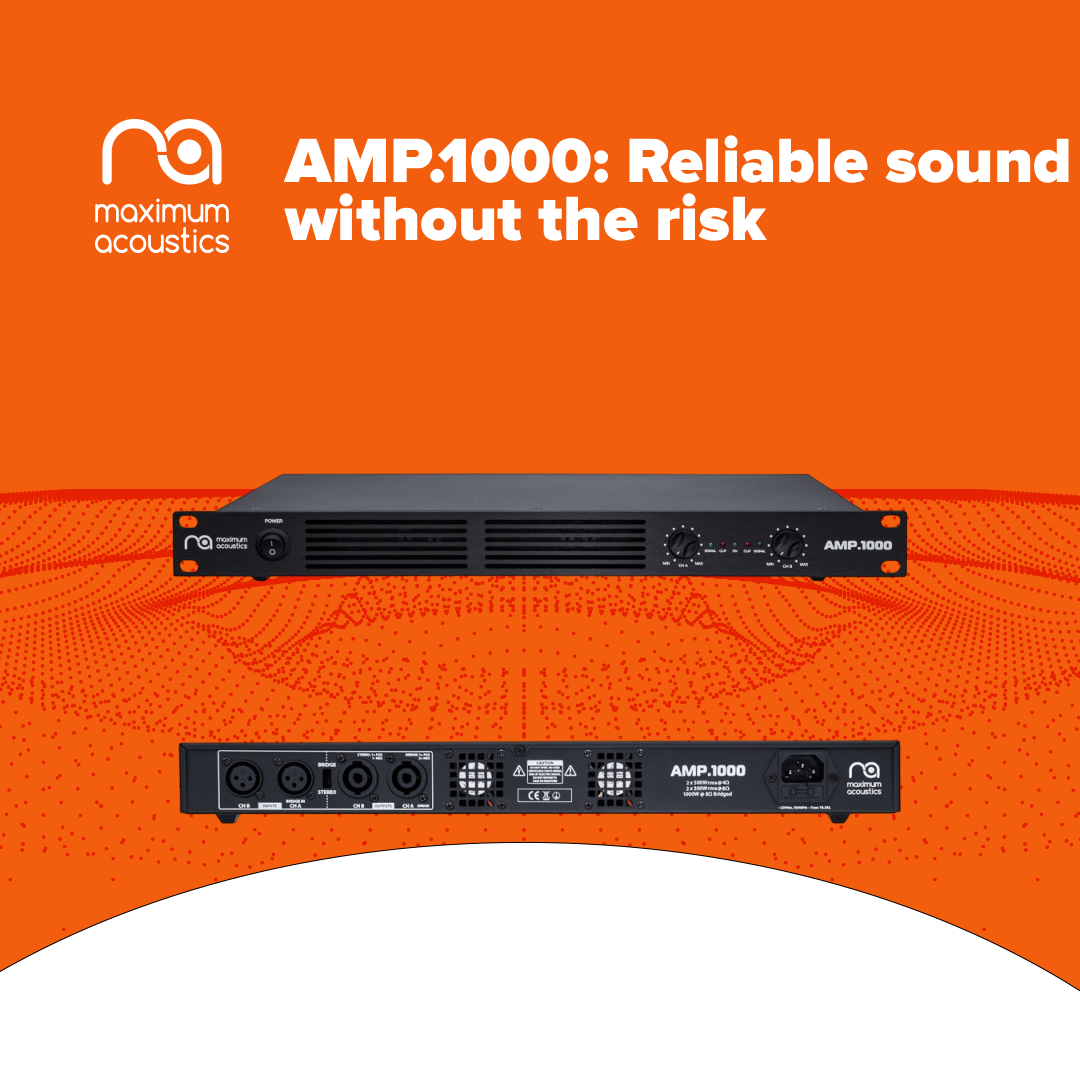
Let’s look at the 5 most common causes of failures and use the Maximum Acoustics AMP.1000 as an example to show how to reduce risks in real-life operation. This amplifier is designed for use in cafés, restaurants, mobile event setups, small concert systems, and installations where power, compact size, and protection against typical operating mistakes are important.
Overheating: when the amplifier operates at a critical temperature
One of the most common reasons an amplifier fails is overheating. It occurs when the equipment is installed in a closed rack without proper air circulation, placed too close to other hot devices, or left uncleaned from dust for years. Under such conditions, even a high-quality amplifier begins to operate in a difficult temperature mode, while electronic components gradually lose their service life.
This problem is especially common in small cafés and restaurants, where audio equipment is hidden in furniture niches, under bar counters, or inside closed cabinets. It may look neat from the outside, but for equipment without ventilation, it is almost always a risk.
To avoid overheating, the amplifier must have access to air, and the rack or cabinet must have proper ventilation. It is also important to clean the equipment from dust regularly, avoid blocking ventilation openings, and keep the device away from heat sources.
Maximum Acoustics AMP.1000 has an important advantage in this regard: it uses a Class D design, which is known for high efficiency and significantly lower heat generation compared to traditional amplifiers of older classes. This means that more energy goes into sound rather than unnecessary heating of the enclosure. In addition, the model is equipped with a low-noise fan and a well-designed cooling system, so the amplifier better withstands long-term operation at events, in food service venues, and in mobile sound systems.
Impedance mismatch: when there are more speakers than the amplifier can handle
The second common cause of failures is incorrect speaker connection by impedance. In simple terms, an amplifier is designed for a certain load, and if too many speakers are connected in parallel, the total impedance may drop below the allowed level. As a result, the amplifier is forced to deliver more current than its design allows, overheats, becomes overloaded, and may fail.
For beginners, this mistake is especially tricky. For example, it may seem logical to connect another pair of passive speakers to make the sound “louder.” But if you do not calculate the total impedance of the system, such an experiment may end with amplifier repair or speaker replacement.
The solution is simple: always check the speaker impedance and connection scheme. Do not lower the load below the level supported by the amplifier. If the system operates in stereo mode, each channel must receive a load with which it can work stably.
The AMP.1000 is designed for confident operation with popular speaker system configurations. It delivers 2 x 500 W at 4 ohms and 2 x 300 W at 8 ohms, making it suitable both for compact passive speaker sets and more powerful solutions. In addition, in Bridge mode, the amplifier can provide 1000 W at 8 ohms, which is useful for connecting a powerful subwoofer or creating a mono-channel system with increased output. The main thing is to match the load correctly and not exceed the permissible parameters.
Clipping and direct current: the red indicator is not decoration
Clipping is another enemy of both sound and equipment. It occurs when the amplifier operates at the limit of its capabilities and can no longer reproduce the signal cleanly. Instead of a normal sound wave, distortion appears, which is dangerous both for the amplifier itself and for the speakers.
In practice, clipping often looks very simple: a sound engineer or DJ increases the volume, the Clip indicator stays on almost constantly, but it seems that “a little more is still fine.” In reality, constant operation in the red zone is a path to overheating, distortion, damage to high-frequency drivers, and serious stress on the amplification circuit.
To avoid this, you need to carefully monitor the indicators, set the levels on the mixer correctly, avoid turning the volume up to maximum unnecessarily, and use limiters if they are available in your system. Good sound is not always “the loudest.” First of all, it is a clean, controlled signal without constant overload.
The front panel of the Maximum Acoustics AMP.1000 features convenient LED Signal and Clip indicators for each channel. The Signal indicator shows the presence of an input signal, while Clip warns that the level has become too high and may cause distortion. For a beginner sound engineer, this is a simple and clear reference point: if Clip flashes occasionally on peaks, the situation is under control, but if it stays on constantly, the level must be reduced. In addition, the AMP.1000 has DC protection, meaning protection against direct current, which can be dangerous for both speakers and the amplifier’s electronics.
Short circuit: the problem is often not in the amplifier, but in the cable
Very often, amplifiers fail not because of their own defect, but because of connection issues. A worn cable, a poorly soldered connector, accidental contact between conductors, or homemade adapters can cause a short circuit at the output. In the best case, the protection system will trigger. In the worst case, the amplifier will suffer serious damage.
This is especially relevant for event DJs and mobile setups, where cables are constantly coiled, transported, lying on the floor, and stepped on by guests or staff. From the outside, a cable may look intact, while already being damaged inside.
To avoid short circuits, it is worth using high-quality speaker cables, regularly checking their condition, and not saving money on connectors. It is also not recommended to connect or disconnect speakers under load at high volume. Before making connections, it is better to turn off the amplifier or at least reduce the levels to minimum.
Maximum Acoustics AMP.1000 is equipped with professional Speakon output connectors, which are much more reliable for connecting passive speakers than random household solutions. Such connectors lock more securely, reduce the risk of accidental cable disconnection, and help prevent dangerous contact between conductors. In addition, the amplifier has built-in short-circuit protection. If a problem still occurs, the protection system should respond before the malfunction turns into a full-scale failure.
Unstable power supply: outdoor and mobile locations are not always equipment-friendly
Another reason that is often forgotten is unstable mains voltage. In restaurants with old wiring, summer terraces, temporary pavilions, or off-site events, the power supply may be far from ideal. Voltage spikes, drops under load, questionable-quality generators, and connecting a large amount of equipment to one line create risks for the entire sound system.
The amplifier is one of the most power-dependent elements of the audio chain. If the power supply is unstable, it may operate incorrectly, shut down, overheat, or become damaged. Therefore, for mobile work, it is advisable to use a voltage stabilizer, high-quality extension cords with the proper cable cross-section, and a separate power line if possible.
The AMP.1000 supports 115 V / 230 V power with voltage selection, which adds versatility when working in different conditions. Its durable metal housing is well suited for rack installation, transportation, and regular use at events. This does not eliminate the need for proper power supply, but it makes the amplifier itself better prepared for a professional environment.
Why Maximum Acoustics AMP.1000 is a practical choice for business and events
The AMP.1000 is a 1000-watt power amplifier in a rackmount form factor that combines compactness, performance, and protection against typical operating risks. It is designed for operation in stereo and bridge modes, features balanced XLR inputs, Speakon outputs for passive loudspeakers, and convenient volume controls for channels A and B.
The amplifier reproduces a frequency range from 20 Hz to 20 kHz with a deviation within ±0.5 dB, making it suitable for full-range music material — from background music in a venue to dynamic DJ sets. The THD+N harmonic distortion level does not exceed 0.05%, which is important for clean sound without unnecessary harshness. A damping factor of 300 helps better control speaker movement, especially in the low-frequency range. The self-noise level is 100 dB, so the amplifier does not add noticeable unwanted background noise in a properly assembled system.
The input impedance is 10 kOhm in unbalanced mode and 20 kOhm in balanced mode, while XLR connectors are used to connect signal sources. Speakon outputs are provided, which are a professional standard for passive speakers. The device has Power, Signal, Clip, Protect, and Bridge Mode indicators, so the user can see the current state of the system without complicated diagnostics. Control is handled by the power button, volume knobs, and the Bridge/Stereo mode switch. The enclosure dimensions are 482 x 180 x 44 mm, so the amplifier can be conveniently installed in a standard rack, while its 2.6 kg weight makes it practical for mobile use.
The warranty deserves separate attention. The AMP.1000 comes with a 36-month warranty, which is a strong argument for those who buy equipment not “for one evening,” but for regular work.
The reliability of a sound system is not luck, but the result of choosing the right equipment and using it properly. Amplifiers most often burn out due to overheating, incorrect load, constant clipping, cable problems, or unstable power supply. All these risks can be significantly reduced if you plan ventilation in advance, check speaker impedance, monitor the indicators, use high-quality connections, and do not ignore the quality of the power supply.
Maximum Acoustics AMP.1000 is an amplifier for those who need power, stability, and clear control over the system. It offers up to 1000 W of power, operates in Class D, has protection against short circuit, DC, overheating, and overload, is equipped with professional XLR and Speakon connectors, and comes with a 3-year warranty.
If you need a reliable amplifier for a café, restaurant, mobile DJ setup, or small concert system, the AMP.1000 for UAH 13,332 will be a confident solution for stable sound without unnecessary risks. Order it so your system operates not at its limit, but with a reserve of power and protection.
Leave your comment