

How to properly place speaker systems in a hall: a guide from Maximum Acoustics
You bought a powerful speaker system, connected it in the hall, and expected dense, clean, professional sound. But instead, you got rumble, an unintelligible “mess,” and a strange situation: it is too loud near the stage, still tolerable in the center, while in the far corner people can barely hear the words. This is a familiar picture for cafés, small restaurants, school assembly halls, church premises, fitness studios, and mobile events.
Most often, the problem is not that the speakers are “bad” or not powerful enough. Even high-quality speakers can sound mediocre if they are placed in the wrong spot, too low, too close to a wall, or without considering the geometry of the room. Sound in a hall does not behave like a uniform wave that fills the entire space equally. It reflects from walls, the ceiling, and the floor, builds up in corners, is partially absorbed by people and furniture, and sometimes even interferes with itself.
In this guide, we will look at two of the most common problems in large and medium-sized rooms — acoustic rumble and “dead zones.” We will also explain how the correct height, speaker angle, tripod stands, wall brackets, and subwoofers help achieve more even, intelligible, and controlled sound without a complex professional installation.
Why rumble appears in a hall
Low frequencies, or bass, have a long sound wave. Unlike high frequencies, they spread almost omnidirectionally and easily accumulate near walls, in corners, and in other acoustically difficult areas. That is why it can sometimes seem that there is not just a lot of bass, but that it is “smeared” across the room and makes it harder to hear vocals, the presenter’s speech, or instruments.
This effect becomes especially noticeable when a speaker system or subwoofer is placed right against the rear wall or pushed into a corner. The walls act as additional reflectors, artificially boosting the low frequencies. At first glance, it may seem that the sound has become more powerful, but in practice, it often loses control. The bass starts to rumble, masks the midrange, and makes speech less intelligible.
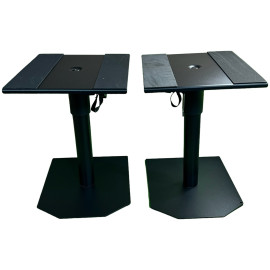
To reduce this effect, it is advisable to move the speakers at least 0.5–1 meter away from the rear and side walls. This simple solution often produces a noticeable result even without additional room treatment. If you are using a mobile setup for events, cafés, or a small stage, it is also worth raising the main speakers above the floor. Maximum Acoustics stands handle this task perfectly, helping not only to set the correct height but also to reduce the unwanted influence of the floor on sound perception.
Our catalog includes steel stands for speaker systems, including models designed for loads of up to 50 kg and height adjustment of approximately up to 2 meters. These solutions are compatible with a standard 35 mm mount, so they are suitable for many popular active and passive speaker systems.
What “dead zones” are and why vocals disappear
While bass behaves broadly and almost omnidirectionally in a room, mid and high frequencies have much more precise directivity. They are responsible for the intelligibility of speech, vocals, guitars, keyboards, and many musical details. They can be compared to a flashlight beam: wherever you point it, that is where it “shines.”
That is why the height of the speakers is critically important. If a speaker system stands on the floor, on a low cabinet, or on an ordinary table, the first rows of listeners literally block the high frequencies with their bodies. People in the front hear too much direct sound, while those sitting or standing farther back mostly receive reflections, low-frequency background, and a less intelligible midrange. This is how “dead zones” appear in a hall — areas where the music seems to be present, but words, vocals, or important details are barely audible.
Another reason for uneven sound is interference. When two speakers operate simultaneously, their sound waves meet in space. If distances, angles, and phases are poorly matched, the sound may be reinforced in some places and partially cancelled in others. That is why the presenter’s voice may sound sharp and loud in one part of the hall, but quiet and indistinct just a few meters away.
Rule one: height matters more than it seems
The main reference point when positioning speakers is the high-frequency driver. It should be at the listeners’ ear level or slightly above it if the speaker is tilted downward toward the audience. In a small café, this may be a height slightly above seated guests, while in an assembly hall or at an event, it may be a position that allows the sound to “shoot” over the first rows.
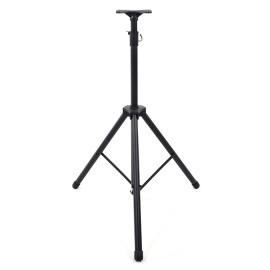
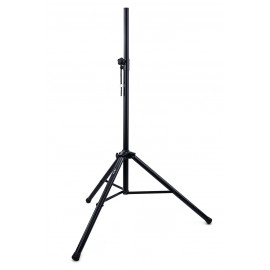
This is where Maximum Acoustics tripod speaker stands become indispensable. They allow you to raise a speaker to approximately 1.5–2 meters, quickly adjust its position for a specific hall, and direct the sound not at the feet of the first listeners, but across the entire audience area. This is especially important for mobile events, because today the system may be used in a restaurant, tomorrow in a school hall, and the day after tomorrow at a presentation or wedding.
The Maximum Acoustics MPS speaker stand, for example, is made of steel, adjustable in height from 1.2 to 2 meters, and designed for loads of up to 50 kg. It is a practical option for small full-range speakers, helping you position the system correctly without complex installation.
Rule two: do not place speakers parallel to the walls
One common mistake is to point speaker systems straight forward, parallel to the side walls. In this position, a significant part of the energy goes not only to the listeners but also into reflections. The sound hits surfaces, returns with a delay, and creates a sense of blurriness.
It is better to turn the speakers slightly inward, directing them toward the imaginary center of the audience area. This technique reduces unwanted reflections from the side walls, improves the stereo image, and helps cover the space more evenly. For a presenter, vocals, or background music, this means one simple but important thing: people do not have to strain to understand the words.
In a mobile configuration, the angle can be easily adjusted thanks to the stands. During soundcheck, you can walk around the hall, listen to where the sound is too harsh or, on the contrary, drops out, and slightly correct the speaker position. In stationary halls, this function is handled by wall brackets with tilt and swivel adjustment.
Rule three: delegate the bass to the subwoofer
If your system includes a separate subwoofer, you should not force the main speakers to handle both vocals and deep low end at the same time. It is better to divide the tasks: the tops should reproduce speech, vocals, and the main musical range, while the subwoofer should handle low frequencies.
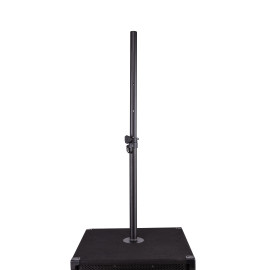
A subwoofer should not be hidden under a table or pushed into a corner just because it is “not for decoration.” Most often, the optimal place for it is on the floor between the main speaker systems or slightly offset from the central axis of the hall. A slight offset helps reduce the risk of standing waves, where there is too much bass in some spots and almost none in others.
In Maximum Acoustics solutions, subwoofers complement the main speaker systems well when you need to provide sound for a dance area, a small concert, a presentation, a banquet, or a church service with musical accompaniment. A separate subwoofer adds depth to the sound, but with proper placement, it should not turn the hall into a booming box. Its job is to support the system from below, not to overpower everything else.
Tripod stands or wall brackets: what to choose
The choice between mobile stands and wall brackets depends on the format of your space. If you work with mobile events, rented halls, cover bands, or temporary installations, tripod stands will be more convenient. They can be quickly set up, folded, transported, and adjusted for a specific audience. It is this mobility that makes them a practical solution for event managers, beginner sound engineers, and teams that frequently change locations.
Maximum Acoustics stands allow you to quickly adjust the height and sound direction during soundcheck. This is especially useful when the hall has an unusual shape, some guests are seated while others are standing, or the stage is not located in the center of the room. At the same time, it should be remembered that tripods take up floor space, so in a dense crowd they should be positioned so that guests do not bump into the supports.
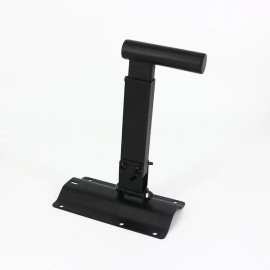
For cafés, restaurants, fitness clubs, churches, conference halls, and school assembly rooms, wall brackets are often more convenient. They free up floor space, look neater, reduce the risk of accidentally knocking over a speaker, and make it easier to organize cables. In a stationary installation, this is not only a matter of aesthetics but also a matter of safety.
An important detail is that a wall-mounted speaker should not simply “look” straight ahead or up at the ceiling. If the speaker is mounted high, the bracket must allow it to be tilted downward and aimed directly at people. In this case, a reinforced mounting plate, reliable tilt fixation, and the absence of play are very important, because they affect the stability of the speaker’s position and the durability of the entire installation.
How to quickly check whether the speakers are positioned correctly
After installing the system, you should not evaluate the sound only from the position near the mixer. Walk around the hall while music is playing or during a microphone test. Listen to the sound near the stage, in the center, near the side walls, and in the last row. If the bass turns into rumble in the corners, try moving the speakers or subwoofer away from the walls. If the voice is difficult to hear at the back, raise the tops higher or change the tilt angle. If the sound drops out in the center, slightly adjust the angle of the speakers.
For small halls, a few simple actions are often enough: raise the speakers on stands, do not place them right against the walls, turn them inward toward the hall, and adjust the subwoofer level separately. This does not replace professional acoustic design for large venues, but for most cafés, school halls, small churches, and local events, it produces a very noticeable result.
To make a hall sound truly professional, you do not always need to buy more expensive speakers. Often, it is enough to correctly position the equipment you already have. Move the speakers away from corners, raise the high-frequency drivers above the heads of the first rows, turn the speaker systems toward the center of the audience, and do not make the tops do the subwoofer’s job.
Maximum Acoustics tripod stands will help you quickly set the correct height for mobile events, wall brackets will become a practical solution for stationary spaces, and subwoofers will add depth to the system without overloading the main speakers. Do not let poor placement spoil the potential of your audio system. Go to the Maximum Acoustics accessories catalog and choose reliable stands, brackets, and bass solutions with an official warranty that will raise your sound to the right height.
Leave your comment